Why are there so many AI Resume Builders requiring monthly subscriptions?
AI made resume tools easier to launch, but recurring pricing is usually driven by SaaS economics more than by how job seekers actually use these products.
This post builds on our original breakdown published on LinkedIn.
Why this category suddenly feels crowded
A big reason is that the barrier to entry is now very low. A small team can stitch together a landing page, a few templates, and an LLM-powered tailoring flow much faster than before, even in a very crowded niche.
That is why so many of these sites feel oddly familiar: the same pale backgrounds, the same rounded cards, the same huge promises, and often the same freemium funnel aimed at people who urgently need to apply for jobs.
Why monthly subscriptions became the default
The simple answer is margin. In our own testing, a basic tailoring request can cost under one cent in AI usage, while many resume tools in this category ask for roughly $20 per month once you want meaningful usage or exports.
From the company side, recurring billing is attractive because it turns a short-term need into predictable SaaS revenue. From the user side, it often feels excessive because resume work usually happens in bursts, not as a monthly habit.
That mismatch explains why so many people bounce off the pricing page. They are trying to improve a document, maybe tailor a few dozen applications, and then move on, not subscribe to yet another always-on platform.
What the price estimates actually look like
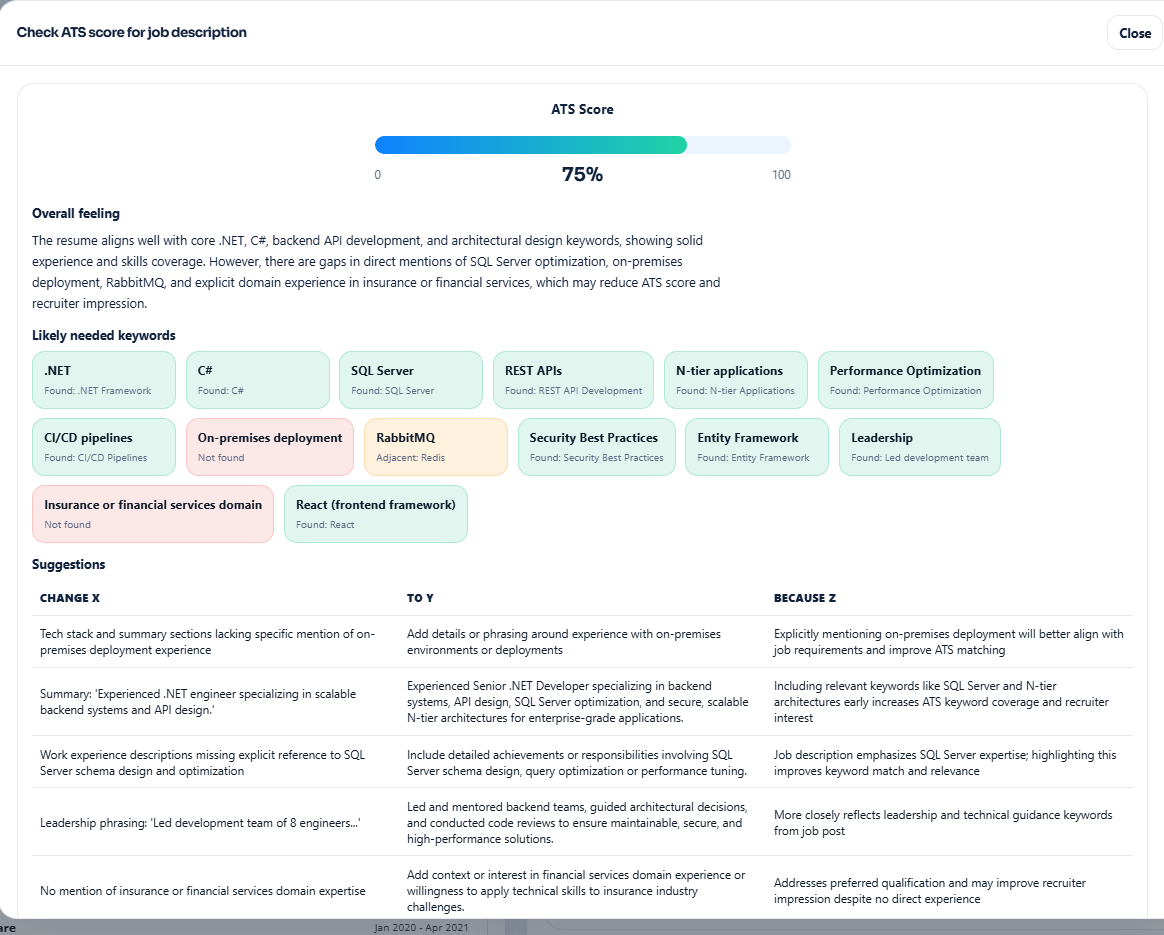
Here is what the pricing can actually look like in practice. A sample batch made up of resume import, ATS scoring, AI tailoring, and a follow-up ATS recheck came in at under 1 cent total in token usage.
That means the spread between infrastructure cost and subscription price can be enormous. In our LinkedIn breakdown, we also estimated that $1 to $2 in tokens could cover dozens, and potentially hundreds, of resume operations depending on the model and workflow. Even if you choose a more expensive model, $20 in API usage can still go a long way without expiring at the end of a billing cycle.
Why that pricing model frustrates users
- The need is temporary: A resume is often a sprint task, not a daily habit.
- The free tier is often tiny: Some tools only allow 1 to 5 resumes before blocking the useful features.
- Exports get locked behind payment: Some tools let you do the work, then charge at the last step.
- Value can feel inflated: AI drafting is useful, but not every user needs a full monthly platform.
- Cancellation fatigue is real: People already manage enough recurring charges elsewhere.
That is why so many job seekers feel a mismatch between the problem they are trying to solve and the pricing they are being offered. It is not that AI features have no cost. It is that a recurring subscription often feels oversized for a tool that may only be needed a few times per year.
An alternative: pay for tokens or run the tool yourself
We built and host NAAW on ATSHelper, short for Not Another AI Wrapper. The idea is straightforward: instead of paying a platform subscription, you bring your own OpenAI API key and pay only for the tokens you actually consume.
If you are comfortable with that setup, you can use the hosted version directly on ATSHelper or clone the GitHub repository and run it locally. For heavier users, that model can be dramatically cheaper because you are paying for actual AI usage rather than a subscription tier designed around lock-in.
That pricing philosophy also lines up with what we value at resume-helper: practical tools, straightforward exports, and AI help when you need it, not a monthly charge that keeps running after the urgent part of the job search is over.
Need a resume tool without the usual friction?
Try the hosted NAAW workflow on ATSHelper and pay for tokens only when you actually use them.
Open NAAW on ATSHelper